Porfirio Díaz to Emilio Rabasa, 1893, Colección Porfirio Díaz, Legajo 18, Documento 012549Governor Licenciado Emilio Rabasa My dear friend -
I have the pleasure to introduce to you, by means of this letter, Mr. Thomas Namoto, who would like to purchase lands in the state which you govern with such dignity in order to establish on them Japanese agricultural colonies. ...
And so on.
This is one I have been looking forward to reading. Why were the Japanese interested in investing in Chiapas? Did the Japanese drink coffee in the late nineteenth century? I have no idea (as yet). I knew this document existed and used it to add to the evidence of internationalism at work in such a remote place when proposing my dissertation. Yet, in itself, it is so straight forward, simple, with little explanation. The letter is not long, no reply is registered. Yet, from here on out, a number of East Asian names do appear in my documents: Kabayashi, Albert Huy, Tock Lee. Never nearing the number of German or Anglo Saxon names, but they were there.
I should like to find out more. Hints, of course a bit dismissive and disgruntled (be happy I don't post their labels for the Chinese) here:
 J García Soto, Soconusco en la historia : historia geografía, etimología, etnografía, arqucología, estadística, producciones. (México, 1964), p. 85.
'Kato, who after opening various businesses, established an ice cream shop at the end of the highway.' Businessmen all, apparently. What became of the interest in land?
United States. Bureau of Foreign and Domestic Commerce, United States. Dept. of Commerce and Labor. Bureau of Statistics, and United States. Bureau of Manufactures, Commercial relations of the United States with foreign countries during the years 1908 (U.S. G.P.O., 1909), p. 164.
United States. Bureau of Foreign Commerce, United States. Dept. of Commerce and Labor. Bureau of Statistics, and United States. Bureau of Manufactures, Special consular reports (G.P.O., 1904), p. 75.
Today, to market. Neither of these is terribly helpful for my work - I have no particular interest in the sale of hats (though it could be a sign of ready money and I do love hats). While the windmills appeared in my search results because of a suggestion of their ready application in parts of Chiapas and the listing of two firms as potential agents, both employing traveling salesmen, I have seen no evidence that such recommendations were ever taken.
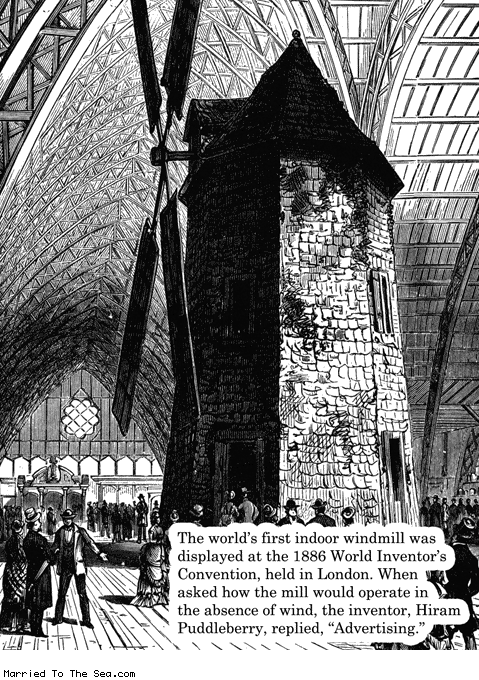
Yet I find the idea charming. Hats - 'felt derby, crushed hat, tourist and fedora ...straw hats... white and stiff with medium-width brim, low crown, and black and fancy bands.' Why not? By 1904 there were plenty of American, German, British gentlemen about, and many a Mexican who set just as jaunty a figure. And why not windmills? Well, there are plenty of reasons, many mentioned later in the piece cited - the need to make them portable, the lack of engineers, the ready water supply - but I now have a pleasant image of natty young men in fedoras strutting amongst windmills.
Which of course leads to this.
 Married to the Sea, 'Indoor Windmill', http://www.marriedtothesea.com/index.php?date=061209, 6/12/09.
 Porfirio Díaz to Emilio Rabasa, 1893, Colección Porfirio Díaz, Legajo 18, Documento 012549
 J García Soto, Soconusco en la historia : historia geografía, etimología, etnografía, arqucología, estadística, producciones. (México, 1964), p. 85.